
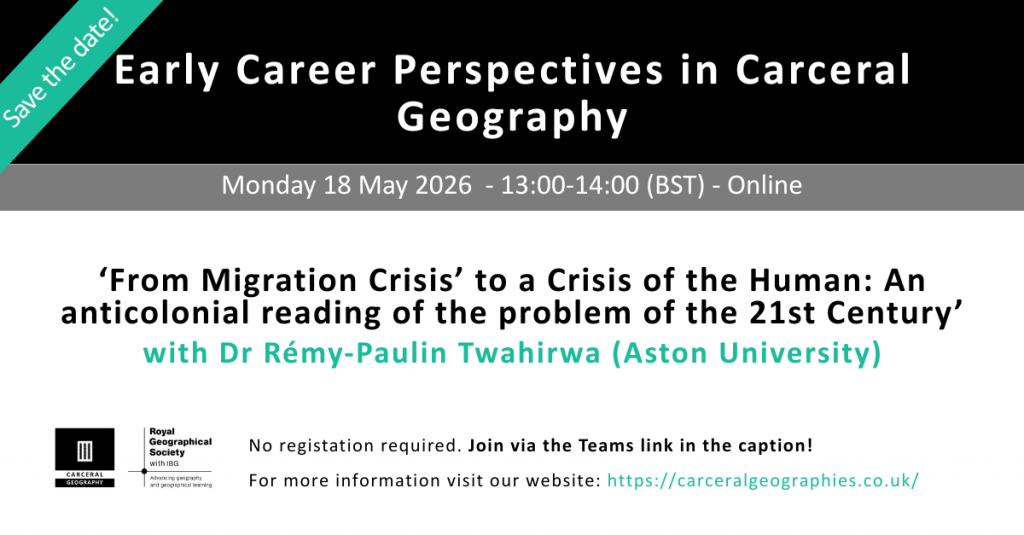
Please join us for an online‑only seminar and Q&A featuring Dr. Rémy‑Paulin Twahirwa (Aston University). Dr. Twahirwa will present their paper: ‘From Migration Crisis to a Crisis of the Human: An Anticolonial Reading of the Problem of the 21st Century’.
Date: Monday 18th May 13:00-14:00 (UK).
No Registration Required.
Link to Online Seminar: Online via Microsoft Teams please use this link on the day to join the seminar
For more information Contact: Renzo Szkwarok (Early Career Perspectives Team).
Email: r.szkwarok1@newcastle.ac.uk
Abstract
The discourse of a ‘migration crisis’—or what Achille Mbembe (2024) has described as the ‘problem of the 21st century’—cannot be understood simply as a matter of numbers, borders, or displaced populations. What is at stake is a deeper and more troubling crisis: a crisis of the human itself. Drawing on anticolonial and postcolonial thinkers, such as Frantz Fanon (2008), Achille Mbembe (2001; 2019; 2024), and Sylvia Wynter (1994; 2001; 2003), this paper argues that the category of the human is neither self-evident nor universal. It is a manufactured story, a system of knowledge and power that has consistently overrepresented European, bourgeois and biocentric ways of being as if they were the only forms of human life. Building on my doctoral research on Britain’s immigration detention estate, I show how the figure of the Migrant comes to stand as a dialectical counterpart to ‘Man’, the privileged subject of the modern nation-state. The forced im/mobility of detained migrants—locked into spaces designed to render them rightless and disposable—exposes the violence inherent in the (un)making of the human. These practices exemplify what Wynter (2003) names ‘descriptive statements’: the classificatory codes that decide who can inhabit the category of the human, and who is cast outside it. To treat migration simply as a political problem is to miss this more profound dimension. Border controls and detention regimes do more than regulate movement; they reproduce colonial grammars of personhood, sustaining hierarchies of life and death that stretch from empire to the present. An anticolonial reading of the ‘migration crisis’ therefore reveals its true stakes: it is not only about the governance of im/mobility, but about the ongoing struggle over what it means, and who is permitted, to be human.
Author-bio
Rémy-Paulin Twahirwa (he/they) is a Postdoctoral Research Associate at Aston University (ESRC-funded project: Peripheralisation of Asylum Accommodation), community organiser and writer based in London. With over a decade of involvement in migrant justice movements in so-called Canada and the UK, their work explores the ghostly affects and matters of migrant life under contemporary border regimes and the parasitic expansion of the carceral state. Their writing has appeared in both academic and non-academic venues, including LSE Review of Books, Society + Space and Liberté. They are currently completing their first manuscript, On Ghostly Lives, and serve as Managing Editor of The Philosopher and co-convenor of the BSA Race and Ethnicity Study Group. rémy also organise screenings with the Haringey Community Cinema. More about their work can be found at: https://ghostlylivesaproject.wordpress.com/. You can follow them on Bleusky: @rpaulint.bsky.social.